

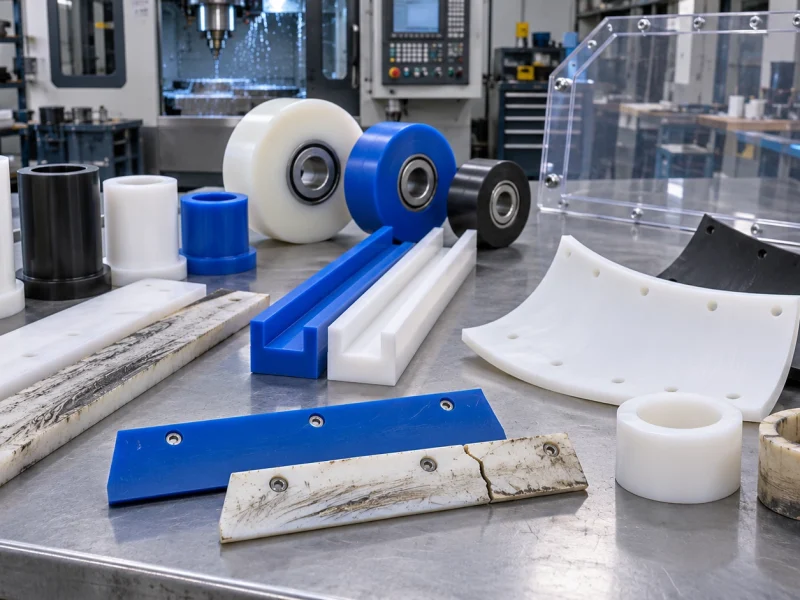
Every machine in your plant has parts that are meant to wear. Wear strips, bushings, liners, guides, scrapers and rollers take the friction, impact and abrasion so the more expensive components around them don’t have to.
That’s their job. But a wear part that’s worn past its limit stops protecting your equipment and starts costing you: jams, misfeeds, noise, damaged product and, sooner or later, an unplanned stop.
The good news is that plastic wear parts almost always give you a warning before they fail. Here’s what to look for, what each sign usually means and how to make sure the replacement outlasts the original.
Why Do Engineered Plastic Wear Parts Still Need Watching?
Engineered plastics like UHMW, nylon and acetal are popular for wear parts because they’re slick, quiet, corrosion resistant and easy on the parts they rub against. In many applications they outlast the metal they replaced. (Still weighing that switch? Read Should This Part Still Be Metal?)
But every material has limits. Load, speed, temperature, chemicals, moisture and abrasive product all take their toll. Knowing the signs lets you replace parts on your schedule instead of your equipment’s.
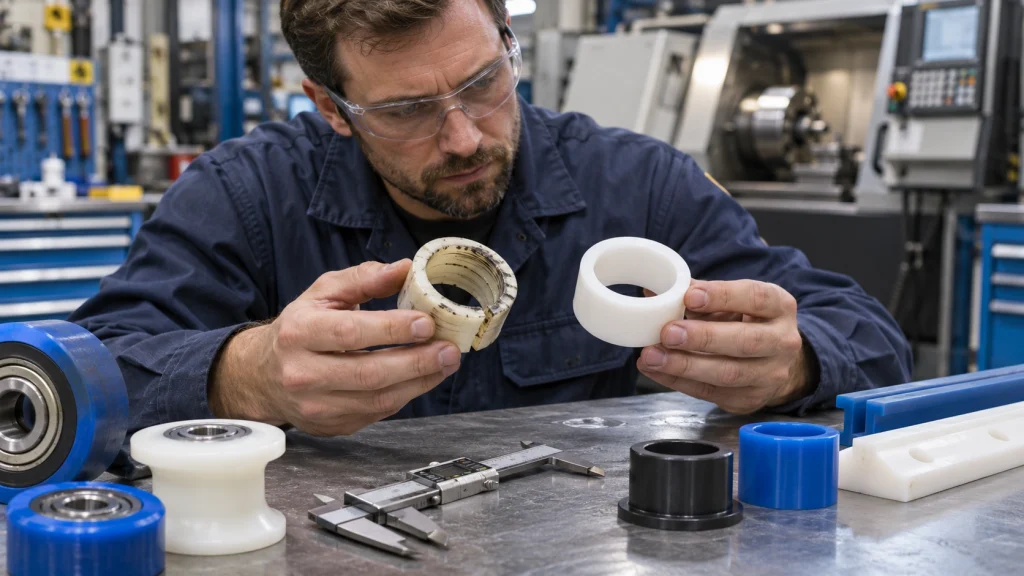
1. Grooves, Channels or Thinning
Where you’ll see it: wear strips, guide rails, chain guides and slide beds on conveyors in food and beverage, packaging and material handling.
What it means: product, chain or belt contact has worn the surface down. Some wear is expected. The question is how much is left. Measure the thickness at the worst spot and compare it with a new part or the drawing. If the wear is getting close to the fasteners or the mounting surface, it’s time.
For the next one: if grooves form quickly, a more abrasion-resistant grade, a thicker profile or a reversible design that can be flipped can add months of life.
2. Excess Play or Wobble
Where you’ll see it: bushings and bearings at pivot points, linkages and shafts on agricultural, construction and heavy equipment, plus conveyors and processing machinery.
What it means: the bore has worn oversized, so the shaft moves where it shouldn’t. That play shows up as noise, misalignment and uneven wear on the shaft itself, which is a far more expensive part to replace.
For the next one: tolerances and material choice matter. Nylon absorbs moisture and can change size in wet environments, while acetal holds its dimensions well. Oil-filled grades like Nyloil add built-in lubrication where greasing is hard to keep up with.
3. Cracks, Chips or Broken Edges
Where you’ll see it: almost anywhere, but especially on parts that take impact, like chute and hopper liners in grain, aggregate and mining applications, and star wheels on packaging lines.
What it means: impact, fatigue, cold temperatures, chemical attack or overtightened fasteners. Cracks that start at sharp inside corners or bolt holes usually point to stress concentration in the design.
For the next one: generous radiuses on corners, counterbored or slotted holes and a tougher material, such as an impact-resistant UHMW grade, can stop cracks before they start.
4. Glazing, Melting or Discoloration
Where you’ll see it: high-speed slides, bushings and bearing surfaces.
What it means: friction is creating more heat than the material can handle. A shiny, glazed surface, melted edges or brown discoloration are all signs the part is running too hot for its load and speed.
For the next one: a material rated for higher temperatures, or a self-lubricating grade such as PTFE or an oil-filled nylon, can cut friction and heat. It’s also worth checking whether speed or load has changed since the part was first specified.
5. Swelling, Warping or Parts That No Longer Fit
Where you’ll see it: washdown areas, wastewater equipment, outdoor equipment and anywhere temperatures swing.
What it means: moisture absorption, chemical exposure or thermal expansion has changed the part’s size or shape. A part that binds, bows or pulls away from its mounting is no longer doing its job.
For the next one: choose a material with low moisture absorption and good chemical resistance for the environment, and design in room for expansion, such as slotted mounting holes on long wear strips. Stress-relieved stock and consistent machining also help a part hold its shape.
6. New Noise, Vibration or Drag
Where you’ll see it: conveyors, rollers, guides and scrapers.
What it means: squealing, chatter, product dragging or a drive motor that seems to work harder than it used to. Worn, rough or contaminated surfaces increase friction long before a part visibly fails.
For the next one: a lower-friction material or a smoother machined finish can make a noticeable difference. On scrapers, wipers and flights, a worn edge that no longer makes full contact should be replaced, not adjusted again.
7. Cloudy, Crazed or Scratched Clear Parts
Where you’ll see it: machine guards, viewing windows and sight glasses.
What it means: cleaning chemicals, solvents, UV exposure or abrasion have damaged the surface. A guard you can’t see through makes it harder for operators to spot problems, which defeats the purpose.
For the next one: the right clear material depends on the conditions. Polycarbonate is known for impact resistance, while some acrylics hold up better to certain chemicals. See how one customer solved it in our cell cast acrylic case study.
How Can You Make the Next Part Last Longer?
- Save the old part. The wear pattern tells the story of how it failed. Send it, or photos of it, with your quote request.
- Describe the operating conditions. Load, speed, temperature, chemicals, washdown, abrasive material and indoor or outdoor use all affect which material will last.
- Revisit the material. The material a part has always been made from isn’t always the best choice for how the equipment runs today.
- Look at the design. Corners, hole placement, thickness and room for expansion can matter as much as the material.
- Track replacements and keep spares. When you know a part’s typical life, you can keep one on the shelf. A blanket order can lock in supply for the year ahead.
- Don’t let a missing drawing stop you. Many parts can be recreated from a sample and measurements. Read The OEM Says the Part Is Obsolete. Now What?
Common Wear Part Materials at a Glance
| Material | Known for | Common wear parts |
|---|---|---|
| UHMW | Abrasion and impact resistance, low friction | Wear strips, guide rails, chute and hopper liners |
| Nylon (including Nyloil) | Strength and wear resistance; Nyloil adds built-in lubrication | Bushings, rollers, gears, sheaves |
| Acetal | Dimensional stability and low moisture absorption | Precision bushings, star wheels, timing parts |
| HDPE | Chemical resistance and value | Liners, scrapers, food processing components |
| PTFE | Very low friction, chemical and heat resistance | Slide pads, bearings, seals |
| Polycarbonate and acrylic | Clarity; polycarbonate for impact, acrylic for clarity and some chemicals | Guards, windows, sight glasses |
FAQ: Plastic Wear Part Replacement
How often should plastic wear parts be replaced? It depends on the part, the material and how hard the equipment runs. The best approach is to inspect wear parts at every scheduled maintenance, note what you find and build a replacement interval from your own history.
Can you make a part without an original drawing? Often, yes. We can work from a sample part, photos and measurements to recreate many components.
Is plastic or metal better for wear parts? It depends on the application. Engineered plastics often win where corrosion, noise, weight or wear on mating parts are concerns. Metal may still be the right call for very high loads or temperatures. We’re happy to talk through your application.
How do I know which material is right? Tell us what the part does and the conditions it runs in. Our team will recommend a material based on wear, impact, temperature, moisture and chemical exposure.
Do you deliver? Yes. We offer regional truck delivery to Chicago, Northwest and North Central Indiana, Southwest Michigan and Southeast Wisconsin, plus nationwide shipping.
Replace It Once, Not Over and Over
Wear parts are supposed to wear. But if you’re replacing the same part again and again, or finding out it’s worn only after something jams, there’s a better way. Catch the signs early, then make the next part from the right material and design for the job.
Konrady Plastics has been working with engineered plastics since 1981. Our ISO 9001:2015 certified, women-owned shop machines wear parts in-house in Portage, Indiana, on CNC mills, routers and Lathes, from one-off replacements to production runs. And 99% of the plastic materials we use are made in the USA.
Have a part that keeps wearing out? Send us the old part, a drawing or a few photos. Request a Quote or call 1.866.KONRADY.